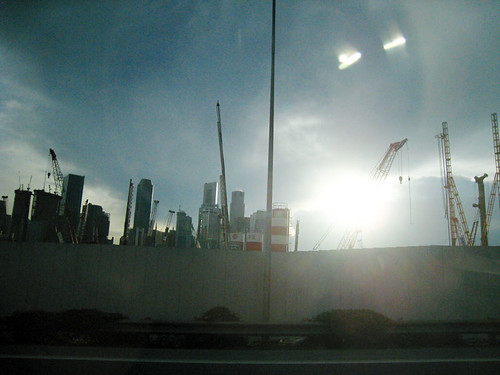
where we used to fly kites
Rudely awakened,
fueled by a yearning-
without the loud sounds of drilling of concrete,
without the incessant nagging by elders;
A place,
where my soul is at peace and mine,
where I can look at the sky and smile,
where I am be-ing my self.
Neurotic to Them,
But I question,
how can one live in a place
where there is We without the I.
(by me)
According to Woolf, being independent--owing nothing to anybody--is essential to achieve the state of mind necessary to produce great art. With material and financial independence, "no force in the world can take from me my five hundred pounds. Food, house and clothing are mine for ever. I need not hate any man; he can not hurt me. I need not flatter any man; he has nothing to give me" (A Room 38). Material independence grants its owner an emotional independence, it allows one to be free of "grudges and spites and antipathies," (A Room 56) to have one's mind unclouded by "alien emotions like fear and hatred" (A Room 58-9). Woolf calls this state of mind "incandescence" (A Room 56).
Perhaps what is most important about the idea of incandescence is its requirement that one be free of emotions rooted in dependent relationships. The "alien emotions" that Woolf names such as "grudges, spites and antipathies" are emotions based in relationships, in communities and in dependencies; they are emotions that exist as reactions to other people--they are reactive, not creative. The idea of incandescence recalls that early memory of being alone, when Woolf's emotional experience was independent of others. As well, it reflects the connection Woolf makes between relationships and dependence when writing about her father and her early life.
In Woolf's view part of the danger of community is that it forces people into dependence, and that dependency locks a person into a limited and rigid world. In A Room of One's Own, this connection is made clear in Woolf's discussion of women's crippling material dependence, which leaves them incapable of producing work with "integrity" (73). This discussion is similar to Woolf's recollection of her father's emotional dependence, which locked him into a limited and dependent state of grief from which he often had "no possibility of communication" (Moments 126). Dependence, whether material or emotional, binds a person to a community, forcing them to live a partial life that is reactive, rather than creative. Independence, on the other hand, frees one to be incandescent, or "disinterested," to be unbound by relationships and communities in which one doesn't believe (Three Guineas 17, 38).
Once it happened that he was celebrating his birthday. his wife and children had given him many presents. He liked their choice immensely, and enjoyed it all thorougly. But soon the architect arrived to set things right, and to take all the decisions in difficult questions. The master greeted him with pleasure, for he had much on his mind.
But the architect did not see the man's joy. He has discovered something quite different and grew pale. "What kind of slippers are these you've got on?", he exclaimed painfully. The master of the house looked at his embroidered slippers, then he breathed in relief. This time he felt quite guiltless. The slippers had been made to the architect's original designs.
So he answered in a superior way, "But Mr Architect, have you already forgotten? You yourself have designed them." "Of course," thundered the architect, "but for the bedroom. They completely disrupt the moode here with these two impossible spots of colour. Can't you see that?!"
"People can inhabit anything. And they can be miserable in anything and ecstatic in anything. More and more I think that architecture has nothing to do with it. Of course, that's both liberating and alarming. But the generic city, the general urban condition, is happening everywhere, and just the fact that it occurs in such enormous quantities must mean that it's habitable. Architecture can't do anything that the culture doesn't. We all complain that we are confronted by urban environments that are completely similar. We say we want to create beauty, identity, quality, singularity. And yet, maybe in truth these cities that we have are desired. Maybe their very characterlessness provides the best context for living."
What happens when we think of archiving is for difference rather than commonality? Difference is not between entities, but the reason for the subject's existence. To paraphrase again, we need to stay away from the dangers in some of the thinking concerning city preservation. The architect is consigned to the potentiality of the existing buildings because these buildings asks nothing of him/her, imposes on him nothing other than its ban (of the new).
an assignment piece i pulled out from my archive as i was clearing my table.
x-posted at Like A Conceit.
===
Architecture for Others.
In feminist academic Mary McLeod’s Everyday and “Other” Spaces, it is pointed out that the efforts of recent celebrated star architects like Zaha Hadid, Daniel Libeskind and Coop Himmelblau possess but a “marginal relation” (McLeod 11) to the production of architecture for the Other. Whilst McLeod credits them for “incredible aesthetic energy and invention of many designs”, she also argues that the “theoretical language” employed by this basket of architects often “violent and sharp […] like a boys’ club” (McLeod 11) and therefore it in no way begins to welcome the nuances of Others in the production of architecture. Whilst this paper does not disagree with McLeod’s assessment of this body of work, it will be argued—with the help of the writings of academic and practitioner Patrik Schumacher—that it is perhaps through such work that we may begin to develop some notion of architecture for Others.
To begin this argument, it is important that McLeod’s stance is sited in its context. McLeod’s main thrust in discounting the efforts produced by recent architects is that “contemporary theorists and deconstructivist architects have focused too exclusively on formal transgression and negation” (McLeod 12) that does not respond to the experiences of Others, insofar as the Others is “experienced differently, at different times, in different cultures, by different people” (McLeod 9). Instead of concepts of space—read as relevant to Others—proffered by Jacque Derrida, Michael Foucault and even Gilles Deleuze, McLeod suggests a look at theories by other personalities i.e. Amongst others, French philosopher Henri Lefebvre’s “everyday life”, Denise Scott Brown and Robert Venturi’s Learning From Las Vegas, and Jane Jacob’s The Death and Life of Great American Cities. She argues that these theorists hold more relevance to our understanding of the place of Others in our social space because of their acceptance and regard for the “everyday pleasure and its intensification” (McLeod 15). Mundane spaces thought traditionally oppressive such as “the home, the public park, and the department store”, McLeod furthers, actually also offer “some degree of comfort, security, autonomy, and even freedom” (McLeod 10). Insisting that the disempowered Others would rather carve a niche in these spaces rather than “pursue the thrills of transgression and ‘difference’” (McLeod 10), McLeod suggests that the problem with the architecture offered by the afore-mentioned architects lies in the fact that their works offer an over-generalised grandiose vision of Others that serves no social purpose beyond generating a different set of architectural aesthetics and forms
McLeod’s frame of argument hangs on a social pulse, and whilst her argument is felt intuitively by many, architecture academic and practitioner Reinhold Martin laments it best in On Theory. In fact, Martin almost explains the practice’s failure to address any social issues by highlighting the commonly held belief that the very nature of the architecture is “so thoroughly disempowered, so culturally marginal” (Martin 2) it cannot possibly do much to bring about social change. Even if it could, McLeod’s assertion that the fixation on “transgression and negation” does little to offer any opportunities for Others is echoed Schumacher. In The AA Design Research Lab – Premises, Agenda, Methods, Schumacher concurs that the “transmission through philosophy [of Derrida and Deleuze]” is not only “loose” but also “offers no a priori guarantee or justification”, specifically to the works of Eisenman and Greg Lynn. Although, unlike McLeod, Schumacher defends the works by these architects as “the expansion of formal repertoires is a non-linear matter beyond calculation and narrow goal-orientation” (Schumacher, “Premise”). Whilst he admits that these works have no “elaborated proposals for a better life”, they do however “pose questions and withdraw the familiar answers” (Schumacher, “Premise”). The tension between the belief of McLeod and Schumacher stems from an intrinsic disparity in the approach the two academics take in assessing the architectural works.
In the case of McLeod, these works have failed on two levels: Theoretically because the architecture of Others is borne from a myopic and uncritical reading of Derrida, et al; Architecturally because such architecture does not begin to address the social function and uses of Others. On the other hand, Schumacher is willing to appropriate this body of works as experiments that “possibilities upon which a goal-oriented search or selection engine can then operate” (Schumacher, “Premise”), suggesting that whilst the answers for the social processes of Others may not yet readily be found, only through continual experiments will any result fruition:
Who is to judge and deny a priori that a strange building will not attract and engender a strangely productive occupation. Such speculative investment might become accepted as intervention research. What right now appears as an assemblage of disjointed trials might soon cohere into a worthwhile development. A decoded architecture—made strange—offers itself to inhabitation as an aleatoric field, anticipating and actively prefacing its own detournment.The truth is, McLeod alone does not have many ready answers to which architectural examples are real Other spaces. She remains tentative in her examples (i.e. Niki de saint-Phalle and Jean Tinguely’s Stravinsky Fountain, and Maya Lin’s Vietnam Veterans Memorial), preferring to look at them as “places that might suggest other urban tactics”, although prescribing them as “architectural space beyond conformity or disruption, both everyday and other” (McLeod 27). Effectively, McLeod keeps her discourse open and unresolved, expectantly awaiting the same thing Schumacher does: That “these new patterns [be] liberated from their current architectural incarceration” (Schumacher). By whom, what and how, according to McLeod, remains a mystery.Schumacher, "Premise"


